ES EN

Publications and reports

AIDeep Economics' living editorial library. Filter by type or tag and access technical notes, reports and papers published from the dashboard.

Cover of Convergencia de Estándares ISO, GFSI y EUDR para el Sistema de Trazabilidad Arroz en Uruguay
Technical report October 2025

Convergencia de Estándares ISO, GFSI y EUDR para el Sistema de Trazabilidad Arroz en Uruguay

Nicolás Giménez · Gustavo Barboza Martignone

El informe analiza la convergencia entre estándares internacionales de trazabilidad y sostenibilidad, incluyendo ISO 22005, esquemas GFSI y el Reglamento Europeo contra la Deforestación. Se propone una arquitectura geoespacial basada en tecnologías GIS y bases de datos relacionales avanzadas que permita gestionar la segregación lógica de granos, validar geolocalización de parcelas y ejecutar análisis de riesgo regulatorio mediante integración con capas satelitales históricas.

Cover of Requerimientos del Software Actualizados - Sistema de Trazabilidad de Arroz Uruguayo
Technical report October 2025

Requerimientos del Software Actualizados - Sistema de Trazabilidad de Arroz Uruguayo

Nicolás Giménez · Fabián Dávila · Gustavo Barboza Martignone

Este informe presenta la actualización de los requerimientos técnicos del sistema integral de trazabilidad, contemplando el seguimiento completo del producto desde la planificación del cultivo hasta su comercialización. Se definen funcionalidades orientadas a asegurar interoperabilidad, privacidad de datos productivos, validación automática de información y cálculo de indicadores de sostenibilidad. La propuesta busca posicionar estratégicamente al arroz uruguayo en mercados internacionales que demandan trazabilidad verificable y cumplimiento ambiental.

Cover of Sistema de Calificación de Integridad de Datos para Trazabilidad de Arroz
Technical report July 2025

Sistema de Calificación de Integridad de Datos para Trazabilidad de Arroz

Nicolás Giménez · Gustavo Barboza Martignone

El documento propone un sistema de evaluación multidimensional orientado a medir la calidad e integridad de los datos utilizados en sistemas de trazabilidad agroalimentaria. La metodología integra dimensiones como veracidad, integridad, trazabilidad, cumplimiento ambiental y seguridad, alineadas con estándares ISO y frameworks internacionales de food safety. El enfoque permite priorizar mejoras tecnológicas y regulatorias, fortaleciendo la confiabilidad operativa y la credibilidad internacional de los sistemas digitales de trazabilidad del arroz.

Cover of Análisis del Estado de la Trazabilidad en Molinos Arroceros en Uruguay 2025
Technical report June 2025

Análisis del Estado de la Trazabilidad en Molinos Arroceros en Uruguay 2025

Fabián Dávila · José Ignacio Rodríguez · Nicolás Giménez

El presente estudio evalúa el estado de la trazabilidad en los principales molinos arroceros de Uruguay, identificando avances vinculados a certificaciones internacionales y las brechas persistentes en digitalización e interoperabilidad de sistemas. A partir de ese diagnóstico se proponen intervenciones graduales para cerrar dichas brechas y fortalecer la transparencia y competitividad del sector en mercados exigentes.

Cover of Requerimientos y Funcionalidades para un Sistema de Trazabilidad de Arroz en Uruguay
Technical report May 2025

Requerimientos y Funcionalidades para un Sistema de Trazabilidad de Arroz en Uruguay

Nicolás Giménez · Fabián Dávila · José Ignacio Rodríguez · Gustavo Barboza Martignone

El documento especifica los requerimientos funcionales y técnicos necesarios para el desarrollo de un sistema integral de trazabilidad del arroz, estructurado en componentes de arquitectura general, frontend y backend. La propuesta contempla gestión geoespacial de establecimientos, captura digital de eventos productivos, generación de remitos electrónicos y vinculación con procesos comerciales. Asimismo, incorpora la capacidad de cálculo automático de huella de carbono y mecanismos de compartición selectiva de información entre actores de la cadena.

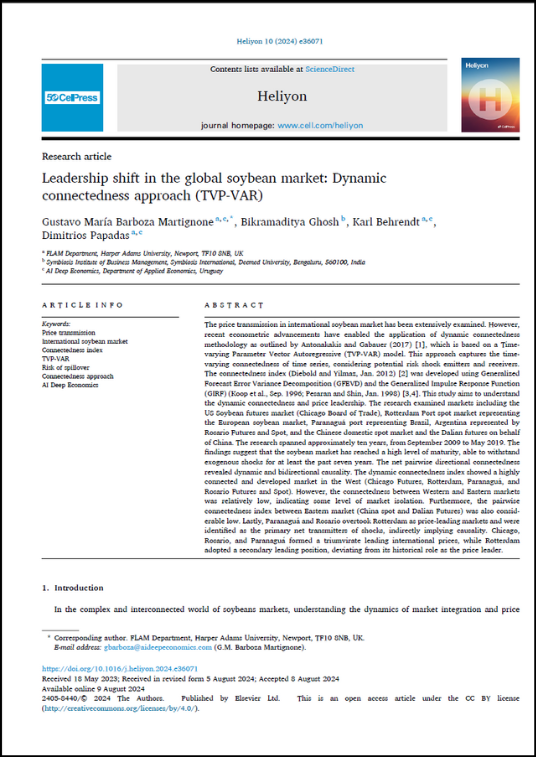
Cover of Leadership Shift in the Global Soybean Market: Dynamic Connectedness Approach (TVP-VAR)
Journal article July 2024

Leadership Shift in the Global Soybean Market: Dynamic Connectedness Approach (TVP-VAR)

Gustavo María Barboza Martignone · Bikramaditya Ghosh · Karl Behrendt · Dimitrios Papadas

The price transmission in international soybean market has been extensively examined. However, recent econometric advancements have enabled the application of dynamic connectedness methodology as outlined by Antonakakis and Gabauer (2017) [1], which is based on a Time-varying Parameter Vector Autoregressive (TVP-VAR) model. This approach captures the time-varying connectedness of time series, considering potential risk shock emitters and receivers. The connectedness index (Diebold and Yilmaz, Jan. 2012) [2] was developed using Generalized Forecast Error Variance Decomposition (GFEVD) and the Generalized Impulse Response Function (GIRF) (Koop et al., Sep. 1996; Pesaran and Shin, Jan. 1998) [3,4]. This study aims to understand the dynamic connectedness and price leadership. The research examined markets including the US Soybean futures market (Chicago Board of Trade), Rotterdam Port spot market representing the European soybean market, Paranaguá port representing Brazil, Argentina represented by Rosario Futures and Spot, and the Chinese domestic spot market and the Dalian futures on behalf of China. The research spanned approximately ten years, from September 2009 to May 2019. The findings suggest that the soybean market has reached a high level of maturity, able to withstand exogenous shocks for at least the past seven years. The net pairwise directional connectedness revealed dynamic and bidirectional causality. The dynamic connectedness index showed a highly connected and developed market in the West (Chicago Futures, Rotterdam, Paranaguá, and Rosario Futures and Spot). However, the connectedness between Western and Eastern markets was relatively low, indicating some level of market isolation. Furthermore, the pairwise connectedness index between Eastern market (China spot and Dalian Futures) was also considerable low. Lastly, Paranaguá and Rosario overtook Rotterdam as price-leading markets and were identified as the primary net transmitters of shocks, indirectly implying causality. Chicago, Rosario, and Paranaguá formed a triumvirate leading international prices, while Rotterdam adopted a secondary leading position, deviating from its historical role as the price leader.

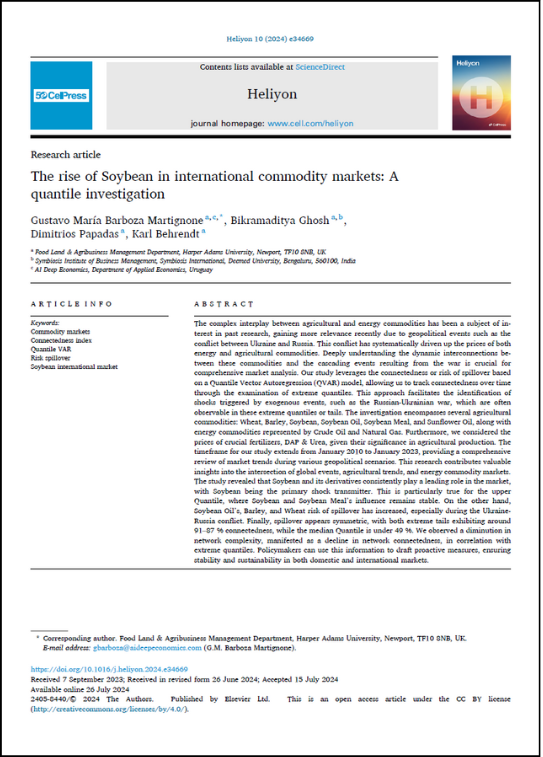
Cover of The Rise of Soybean in International Commodity Markets: A Quantile Investigation
Journal article June 2024

The Rise of Soybean in International Commodity Markets: A Quantile Investigation

Gustavo María Barboza Martignone · Bikramaditya Ghosh · Dimitrios Papadas · Karl Behrendt

The complex interplay between agricultural and energy commodities has been a subject of interest in past research, gaining more relevance recently due to geopolitical events such as the conflict between Ukraine and Russia. This conflict has systematically driven up the prices of both energy and agricultural commodities. Deeply understanding the dynamic interconnections between these commodities and the cascading events resulting from the war is crucial for comprehensive market analysis. Our study leverages the connectedness or risk of spillover based on a Quantile Vector Autoregression (QVAR) model, allowing us to track connectedness over time through the examination of extreme quantiles. This approach facilitates the identification of shocks triggered by exogenous events, such as the Russian-Ukrainian war, which are often observable in these extreme quantiles or tails. The investigation encompasses several agricultural commodities: Wheat, Barley, Soybean, Soybean Oil, Soybean Meal, and Sunflower Oil, along with energy commodities represented by Crude Oil and Natural Gas. Furthermore, we considered the prices of crucial fertilizers, DAP & Urea, given their significance in agricultural production. The timeframe for our study extends from January 2010 to January 2023, providing a comprehensive review of market trends during various geopolitical scenarios. This research contributes valuable insights into the intersection of global events, agricultural trends, and energy commodity markets. The study revealed that Soybean and its derivatives consistently play a leading role in the market, with Soybean being the primary shock transmitter. This is particularly true for the upper Quantile, where Soybean and Soybean Meal's influence remains stable. On the other hand, Soybean Oil's, Barley, and Wheat risk of spillover has increased, especially during the Ukraine-Russia conflict. Finally, spillover appears symmetric, with both extreme tails exhibiting around 91–87 % connectedness, while the median Quantile is under 49 %. We observed a diminution in network complexity, manifested as a decline in network connectedness, in correlation with extreme quantiles. Policymakers can use this information to draft proactive measures, ensuring stability and sustainability in both domestic and international markets.

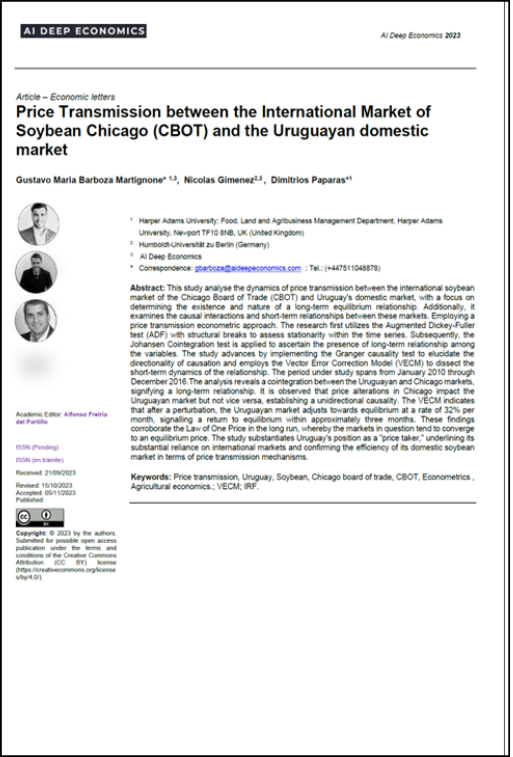
Cover of Price Transmission between the International Market of Soybean Chicago (CBOT) and the Uruguayan Domestic Market
Journal article October 2023

Price Transmission between the International Market of Soybean Chicago (CBOT) and the Uruguayan Domestic Market

Gustavo Maria Barboza Martignone · Nicolás Giménez · Dimitrios Paparas

This study analyse the dynamics of price transmission between the international soybean market of the Chicago Board of Trade (CBOT) and Uruguay's domestic market, with a focus on determining the existence and nature of a long-term equilibrium relationship. Additionally, it examines the causal interactions and short-term relationships between these markets. Employing a price transmission econometric approach. The research first utilizes the Augmented Dickey-Fuller test (ADF) with structural breaks to assess stationarity within the time series. Subsequently, the Johansen Cointegration test is applied to ascertain the presence of long-term relationship among the variables. The study advances by implementing the Granger causality test to elucidate the directionality of causation and employs the Vector Error Correction Model (VECM) to dissect the short-term dynamics of the relationship. The period under study spans from January 2010 through December 2016. The analysis reveals a cointegration between the Uruguayan and Chicago markets, signifying a long-term relationship. It is observed that price alterations in Chicago impact the Uruguayan market but not vice versa, establishing a unidirectional causality. The VECM indicates that after a perturbation, the Uruguayan market adjusts towards equilibrium at a rate of 32% per month, signalling a return to equilibrium within approximately three months. These findings corroborate the Law of One Price in the long run, whereby the markets in question tend to converge to an equilibrium price. The study substantiates Uruguay's position as a "price taker," underlining its substantial reliance on international markets and confirming the efficiency of its domestic soybean market in terms of price transmission mechanisms.

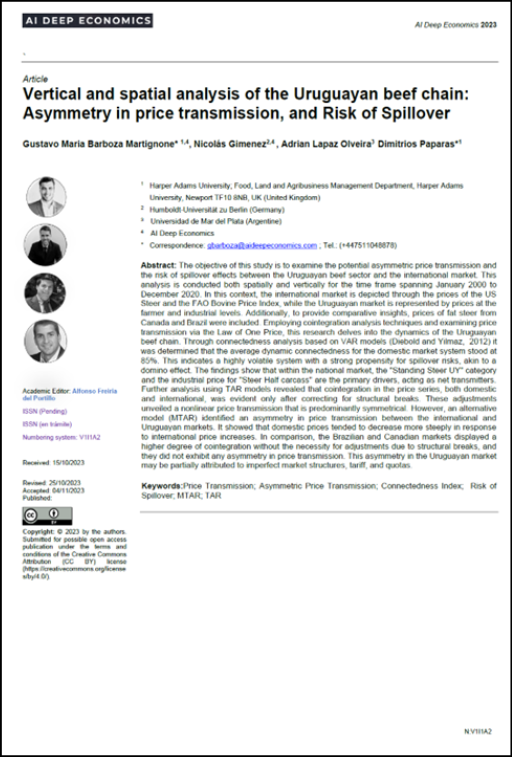
Cover of Vertical and Spatial Analysis of the Uruguayan Beef Chain: Asymmetry in Price Transmission, and Risk of Spillover
Journal article October 2023

Vertical and Spatial Analysis of the Uruguayan Beef Chain: Asymmetry in Price Transmission, and Risk of Spillover

Gustavo Maria Barboza Martignone · Nicolás Giménez · Adrian Lapaz Olveira · Dimitrios Paparas

The objective of this study is to examine the potential asymmetric price transmission and the risk of spillover effects between the Uruguayan beef sector and the international market. This analysis is conducted both spatially and vertically for the time frame spanning January 2000 to December 2020. In this context, the international market is depicted through the prices of the US Steer and the FAO Bovine Price Index, while the Uruguayan market is represented by prices at the farmer and industrial levels. Additionally, to provide comparative insights, prices of fat steer from Canada and Brazil were included. Employing cointegration analysis techniques and examining price transmission via the Law of One Price, this research delves into the dynamics of the Uruguayan beef chain. Through connectedness analysis based on VAR models (Diebold and Yilmaz, 2012) it was determined that the average dynamic connectedness for the domestic market system stood at 85%. This indicates a highly volatile system with a strong propensity for spillover risks, akin to a domino effect. The findings show that within the national market, the "Standing Steer UY" category and the industrial price for "Steer Half carcass" are the primary drivers, acting as net transmitters. Further analysis using TAR models revealed that cointegration in the price series, both domestic and international, was evident only after correcting for structural breaks. These adjustments unveiled a nonlinear price transmission that is predominantly symmetrical. However, an alternative model (MTAR) identified an asymmetry in price transmission between the international and Uruguayan markets. It showed that domestic prices tended to decrease more steeply in response to international price increases. In comparison, the Brazilian and Canadian markets displayed a higher degree of cointegration without the necessity for adjustments due to structural breaks, and they did not exhibit any asymmetry in price transmission. This asymmetry in the Uruguayan market may be partially attributed to imperfect market structures, tariff, and quotas.

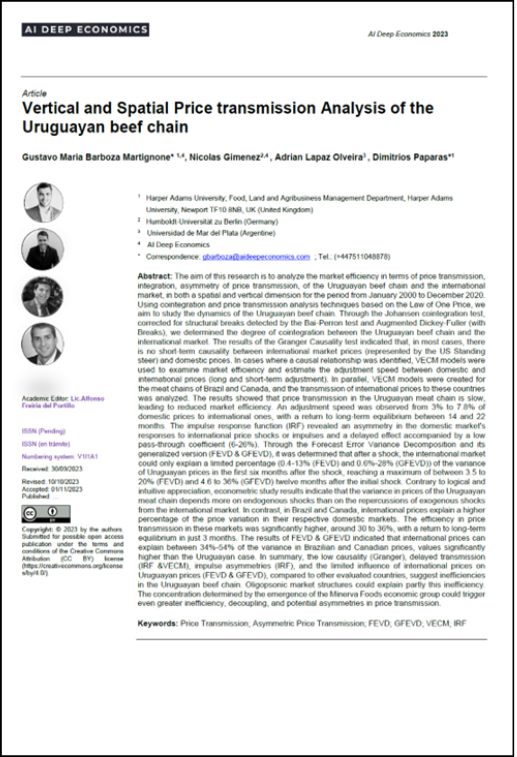
Cover of Vertical and Spatial Price Transmission Analysis of the Uruguayan Beef Chain
Journal article October 2023

Vertical and Spatial Price Transmission Analysis of the Uruguayan Beef Chain

Gustavo Maria Barboza Martignone · Nicolás Giménez · Adrian Lapaz Olveira · Dimitrios Paparas

The aim of this research is to analyze the market efficiency in terms of price transmission, integration, asymmetry of price transmission, of the Uruguayan beef chain and the international market, in both a spatial and vertical dimension for the period from January 2000 to December 2020. Using cointegration and price transmission analysis techniques based on the Law of One Price, we aim to study the dynamics of the Uruguayan beef chain. Through the Johansen cointegration test, corrected for structural breaks detected by the Bai-Perron test and Augmented Dickey-Fuller (with Breaks), we determined the degree of cointegration between the Uruguayan beef chain and the international market. The results of the Granger Causality test indicated that, in most cases, there is no short-term causality between international market prices (represented by the US Standing steer) and domestic prices. In cases where a causal relationship was identified, VECM models were used to examine market efficiency and estimate the adjustment speed between domestic and international prices (long and short-term adjustment). In parallel, VECM models were created for the meat chains of Brazil and Canada, and the transmission of international prices to these countries was analyzed. The results showed that price transmission in the Uruguayan meat chain is slow, leading to reduced market efficiency. An adjustment speed was observed from 3% to 7.8% of domestic prices to international ones, with a return to long-term equilibrium between 14 and 22 months. The impulse response function (IRF) revealed an asymmetry in the domestic market's responses to international price shocks or impulses and a delayed effect accompanied by a low pass-through coefficient (6-26%). Through the Forecast Error Variance Decomposition and its generalized version (FEVD & GFEVD), it was determined that after a shock, the international market could only explain a limited percentage (0.4-13% (FEVD) and 0.6%-28% (GFEVD)) of the variance of Uruguayan prices in the first six months after the shock, reaching a maximum of between 3.5 to 20% (FEVD) and 4.6 to 36% (GFEVD) twelve months after the initial shock. Contrary to logical and intuitive appreciation, econometric study results indicate that the variance in prices of the Uruguayan meat chain depends more on endogenous shocks than on the repercussions of exogenous shocks from the international market. In contrast, in Brazil and Canada, international prices explain a higher percentage of the price variation in their respective domestic markets. The efficiency in price transmission in these markets was significantly higher, around 30 to 36%, with a return to long-term equilibrium in just 3 months. The results of FEVD & GFEVD indicated that international prices can explain between 34%-54% of the variance in Brazilian and Canadian prices, values significantly higher than the Uruguayan case. In summary, the low causality (Granger), delayed transmission (IRF & VECM), impulse asymmetries (IRF), and the limited influence of international prices on Uruguayan prices (FEVD & GFEVD), compared to other evaluated countries, suggest inefficiencies in the Uruguayan beef chain. Oligopsonic market structures could explain partly this inefficiency. The concentration determined by the emergence of the Minerva Foods economic group could trigger even greater inefficiency, decoupling, and potential asymmetries in price transmission.


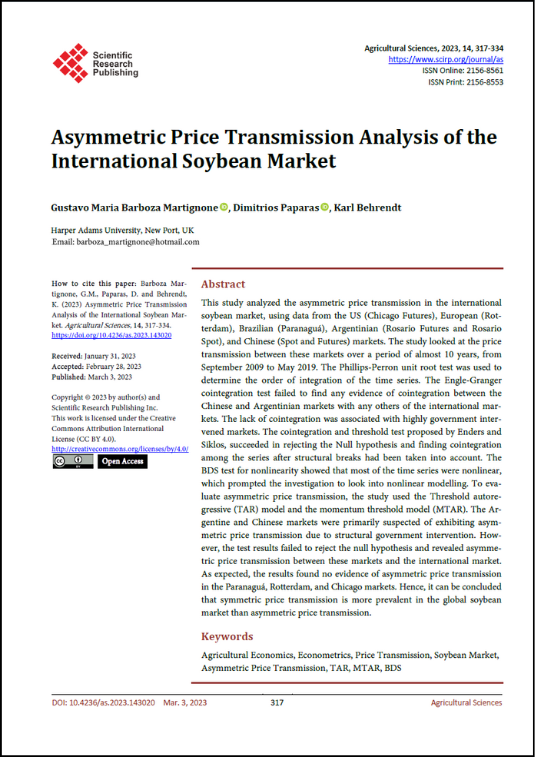
Cover of Asymmetric Price Transmission Analysis of the International Soybean Market
Journal article February 2023

Asymmetric Price Transmission Analysis of the International Soybean Market

Gustavo Maria Barboza Martignone · Dimitrios Paparas · Karl Behrendt

This study analyzed the asymmetric price transmission in the international soybean market, using data from the US (Chicago Futures), European (Rotterdam), Brazilian (Paranaguá), Argentinian (Rosario Futures and Rosario Spot), and Chinese (Spot and Futures) markets. The study looked at the price transmission between these markets over a period of almost 10 years, from September 2009 to May 2019. The Phillips-Perron unit root test was used to determine the order of integration of the time series. The Engle-Granger cointegration test failed to find any evidence of cointegration between the Chinese and Argentinian markets with any others of the international markets. The lack of cointegration was associated with highly government intervened markets. The cointegration and threshold test proposed by Enders and Siklos, succeeded in rejecting the Null hypothesis and finding cointegration among the series after structural breaks had been taken into account. The BDS test for nonlinearity showed that most of the time series were nonlinear, which prompted the investigation to look into nonlinear modelling. To evaluate asymmetric price transmission, the study used the Threshold autoregressive (TAR) model and the momentum threshold model (MTAR). The Argentine and Chinese markets were primarily suspected of exhibiting asymmetric price transmission due to structural government intervention. However, the test results failed to reject the null hypothesis and revealed asymmetric price transmission between these markets and the international market. As expected, the results found no evidence of asymmetric price transmission in the Paranaguá, Rotterdam, and Chicago markets. Hence, it can be concluded that symmetric price transmission is more prevalent in the global soybean market than asymmetric price transmission.

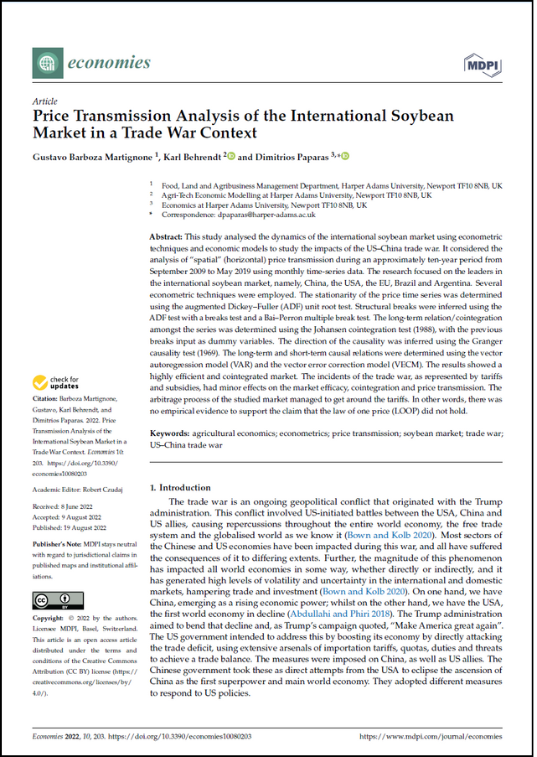
Cover of Price Transmission Analysis of the International Soybean Market in a Trade War Context
Journal article July 2022

Price Transmission Analysis of the International Soybean Market in a Trade War Context

Gustavo Barboza Martignone · Karl Behrendt · Dimitrios Paparas

This study analysed the dynamics of the international soybean market using econometric techniques and economic models to study the impacts of the US–China trade war. It considered the analysis of "spatial" (horizontal) price transmission during an approximately ten-year period from September 2009 to May 2019 using monthly time-series data. The research focused on the leaders in the international soybean market, namely, China, the USA, the EU, Brazil and Argentina. Several econometric techniques were employed. The stationarity of the price time series was determined using the augmented Dickey–Fuller (ADF) unit root test. Structural breaks were inferred using the ADF test with a breaks test and a Bai–Perron multiple break test. The long-term relation/cointegration amongst the series was determined using the Johansen cointegration test (1988), with the previous breaks input as dummy variables. The direction of the causality was inferred using the Granger causality test (1969). The long-term and short-term causal relations were determined using the vector autoregression model (VAR) and the vector error correction model (VECM). The results showed a highly efficient and cointegrated market. The incidents of the trade war, as represented by tariffs and subsidies, had minor effects on the market efficacy, cointegration and price transmission. The arbitrage process of the studied market managed to get around the tariffs. In other words, there was no empirical evidence to support the claim that the law of one price (LOOP) did not hold.